The evidence behind Intelligent Material in one place: selected papers co-authored by IMS, the field studies that use our reporter crystals, our U.S. patents, and measurements from the IMS lab in Princeton.
Measured data plotted from IMS lab recordingsIllustration drawn by IMS to explain
Selected publications
2018
MRS Advances · Materials Research SocietyThermal and optical characterization of upconverting thermographic phosphor polymer composite filmsF. Sabri, S. W. Allison, M. Aryal, J. Collins, H. Bell (IMS)
Rare-earth phosphors in flexible silicone films as reusable temperature sensors, read with a 980 nm laser from −50 to +200 °C. See the thermal data and Intelligent Material as sensors.
Materials Science and Engineering C 70, 76–84Nanoscale upconversion for oxygen sensingK. Presley, J. Hwang, S. Cheong, R. Tilley, J. Collins (IMS), M. Viapiano, J. Lannutti
IMS nanocrystals in the shell of electrospun core-shell fibers turn infrared light into blue light that powers an oxygen-sensing dye; the red glow dims in proportion to oxygen. Aimed at reading oxygen deep in tissue, for example in brain tumors. See it on the Sensors page →
Sensors and Actuators B: ChemicalUpconverter-powered oxygen sensing in electrospun polymeric bilayersK. F. Presley, S. Cheong, A. Cochran, R. D. Tilley, J. E. Collins (IMS), J. J. Lannutti
A two-layer nanofiber mat: IMS crystals in one layer, an oxygen-sensitive dye in the other. Infrared in, oxygen reading out, with response times under a quarter of a second. See it on the Sensors page →
Nature Chemistry 5, 466–473Competition of shape and interaction patchiness for self-assembling nanoplatesX. Ye, J. Chen, M. Engel, A. J. Millan, W. Li, L. Qi, G. Xing, J. E. Collins (IMS), C. R. Kagan, J. Li, S. C. Glotzer, C. B. Murray
Why rare-earth plates pack the way they do: shape competes with how strongly the coating grips each edge.
PNAS 107, 22430–22435Morphologically controlled synthesis of colloidal upconversion nanophosphors and their shape-directed self-assemblyX. Ye, J. E. Collins (IMS), Y. Kang, J. Chen, D. T. N. Chen, A. G. Yodh, C. B. Murray
One recipe grows upconverting crystals as spheres, rods, prisms or plates, all the same size, which then self-assemble.
Every paper, starting with the latest field study.
Dr. Paul Corstjens and his colleagues at LUMC turned upconverting crystal reporters into quantitative lateral-flow tests and validated them with patients and animals on three continents. The list also includes the papers co-authored by IMS scientists. ★ marks papers where Dr. Corstjens is first author. Links open PubMed or the journal. See how the work feeds our diagnostics programs.
From PubMed, October 2026. The upconverting reporter crystals in Dr. Corstjens’s UCP lateral-flow tests were supplied by IMS. Many of these papers are field evaluations that use the UCP-LF test as their reference method.
Where it comes from
1993
J. Am. Chem. Soc. 115, 8706–8715Synthesis and characterization of nearly monodisperse CdE (E = S, Se, Te) semiconductor nanocrystallitesC. B. Murray, D. J. Norris, M. G. Bawendi
The uniform-nanocrystal synthesis recognized by the 2023 Nobel Prize in Chemistry. Christopher Murray is an inventor on the IMS / Penn uniform-crystal patents.
Metallurgical Transactions 2, 763–767Rare-earth-doped oxysulfides for GaAs-pumped luminescent devicesP. N. Yocom, J. P. Wittke, I. Ladany, RCA Laboratories, Princeton
Infrared-to-visible rare-earth oxysulfides, reported from the RCA building IMS works in today. See it measured on Our data.
Intelligent Material Solutions holds the intellectual property; NovaVera Corp. makes and sells Intelligent Material under an exclusive license. IMS holds 21 U.S. patents; key ones are listed here, and each link opens the patent in Google Patents.
For annotated patents, with what each one covers in plain words, see the IP & patents page →
Every measurement on this page comes from this setup. The controller can hold each laser steady or drive it with any waveform, so the crystal can be questioned with almost any mix of infrared light.
Illustration
1
ProgramAn 8-channel current source sets each laser diode's drive current: steady, pulsed or any waveform.
2
CombineGold mirrors steer the 808 to 1625 nm beams onto a near-infrared grating that merges them into one beam.
3
ExciteThe combined beam is focused onto Gd₂O₂S:Er 6% on a glass slide.
4
CollectA 10× objective gathers the visible emission; a visible grating separates blue, green and red.
5
Record and adjustThe recorder logs each color over time and feeds it back to the controller, closing the loop for the next run.
Measured data · luminescence traces
Change the light mix. Watch the crystal answer.
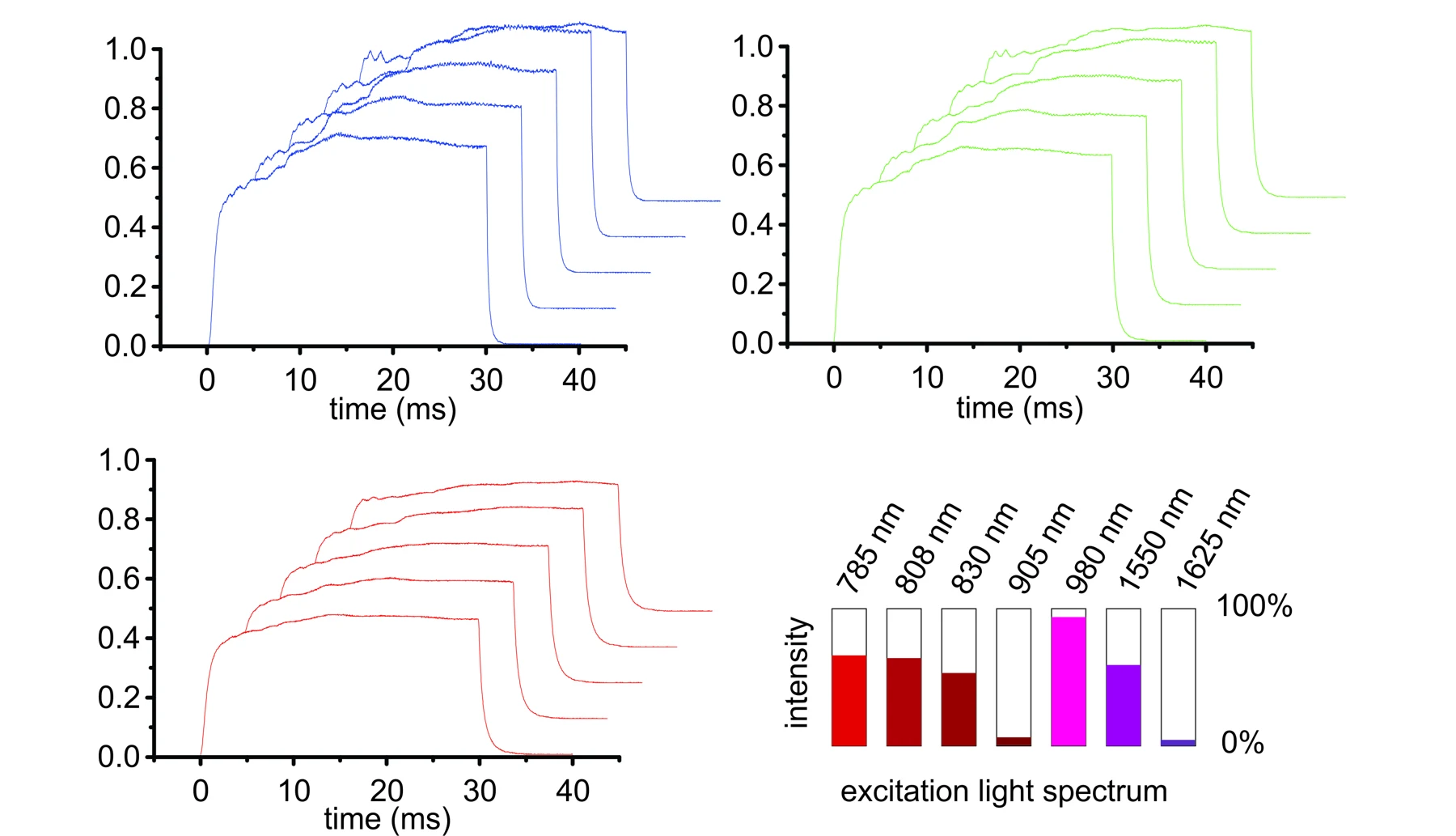
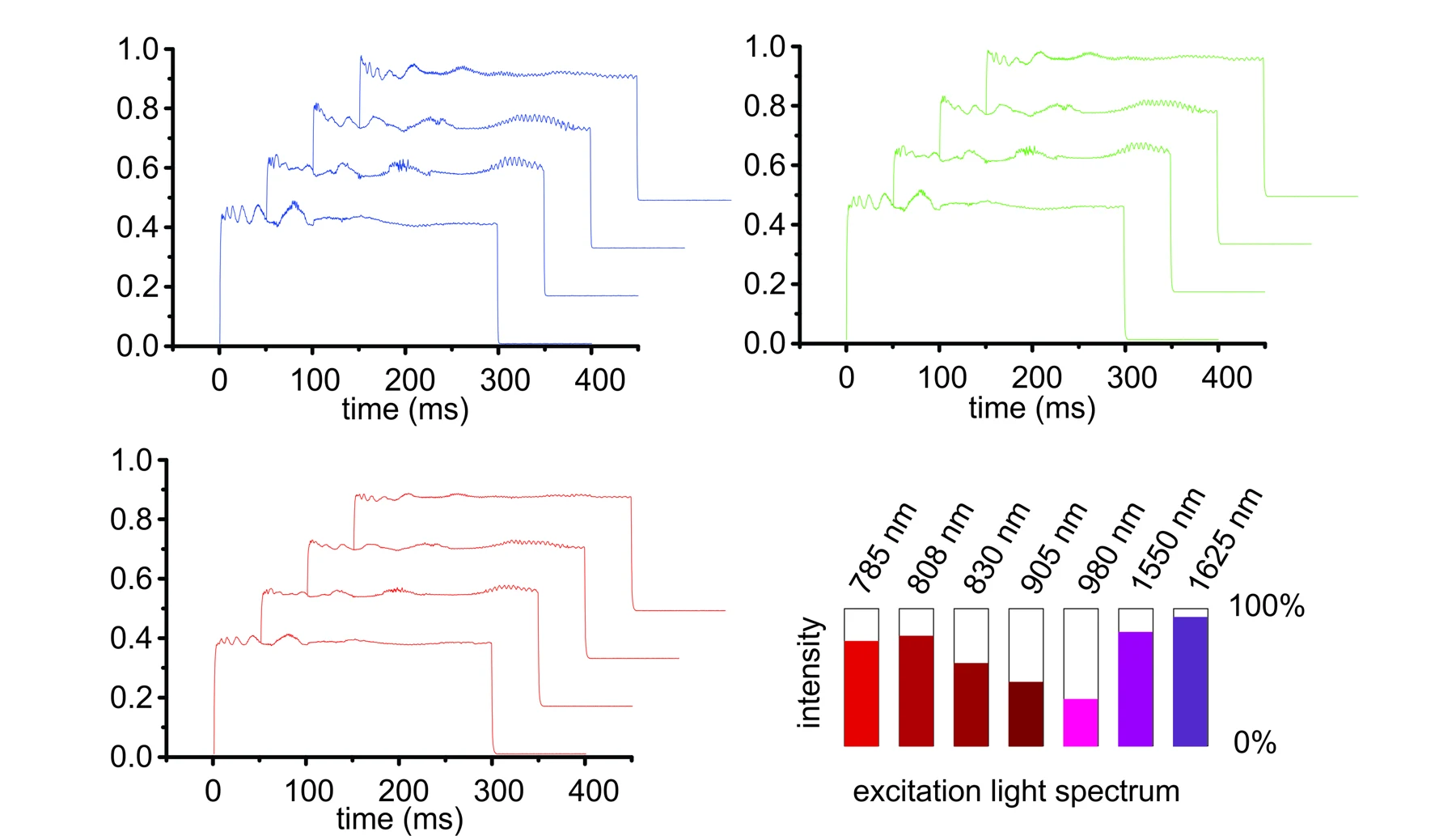
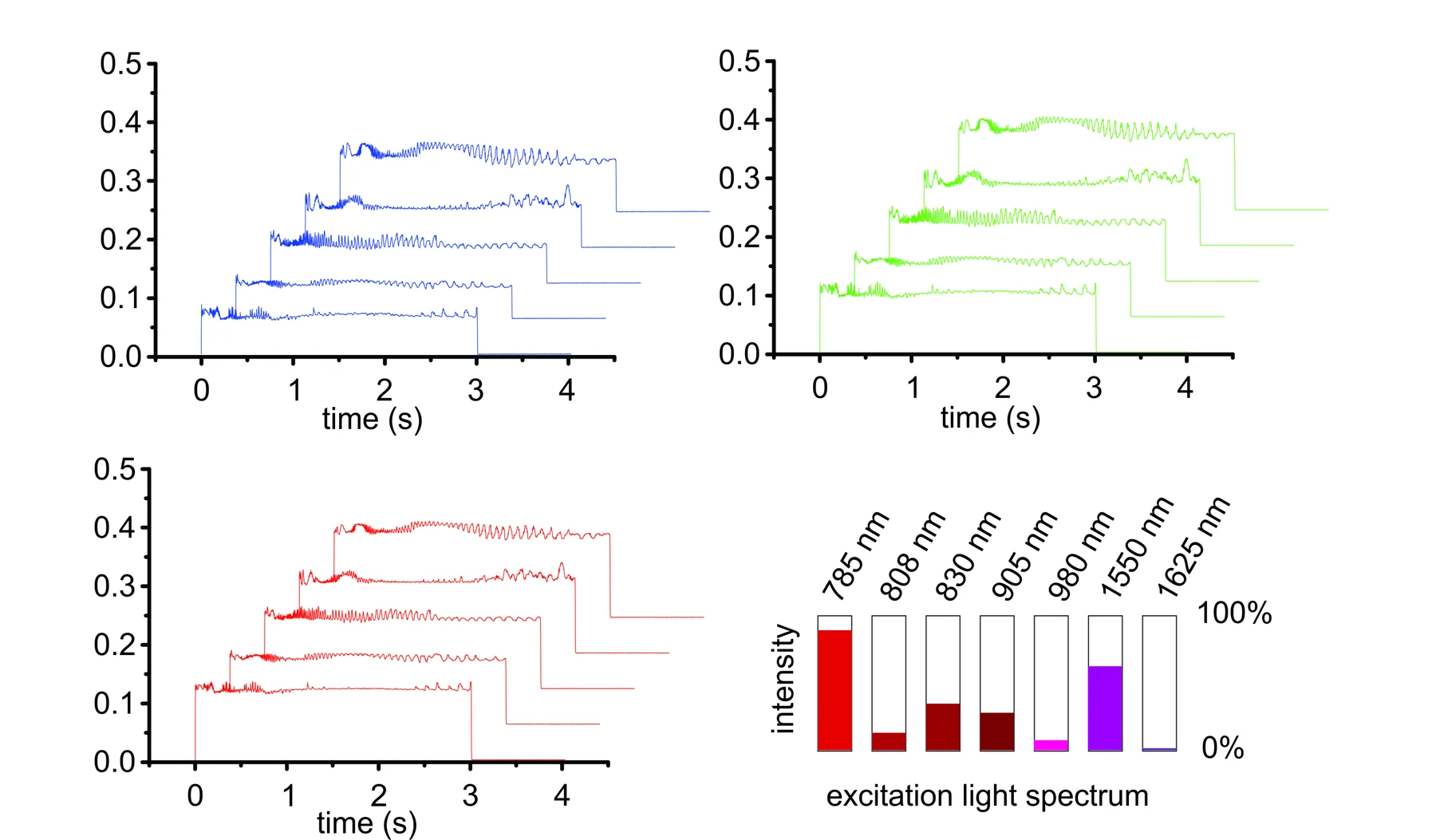
Each run blends seven near-infrared lasers in a set proportion, shown by the bars, and records blue, green and red emission at the same time. Choose a pulse length.
Measured data
30 ms excitation
Each laser mix is held for 30 ms, so you can see the light build up over the first milliseconds and fade after the lasers switch off.
Top left · blue
Top right · green
Bottom left · red
Bars · laser mix
Vertical axis: normalized luminescence. Successive traces are offset in time and height so they can be compared side by side. Bars: relative intensity of each laser (785, 808, 830, 905, 980, 1550, 1625 nm) in that run.
Measured data
300 ms excitation
Held ten times longer. The emission settles to a steady level within a few milliseconds and holds for the whole pulse.
Top left · blue
Top right · green
Bottom left · red
Bars · laser mix
Vertical axis: normalized luminescence. Successive traces are offset in time and height so they can be compared side by side. Bars: relative intensity of each laser (785, 808, 830, 905, 980, 1550, 1625 nm) in that run.
Measured data
3 s excitation
Held for three seconds with a different laser mix. The output stays flat for seconds at a time: a steady, repeatable signal.
Top left · blue
Top right · green
Bottom left · red
Bars · laser mix
Vertical axis: normalized luminescence. Successive traces are offset in time and height so they can be compared side by side. Bars: relative intensity of each laser (785, 808, 830, 905, 980, 1550, 1625 nm) in that run.
Three colors at once
One crystal, three channels.
Erbium gives off blue, green and red light together. Each color is recorded on its own, so a single reading carries three signals, not one.
The mix matters
The excitation is part of the code.
Each run uses a different blend of lasers. Which wavelengths, how strong and for how long are all choices the reader makes, and the crystal's answer depends on all three.
Rise, hold, fade
Timing is information.
The 30 ms traces show how the light builds and fades. IMS readers use timing as well as color; see U.S. Patent 11,922,265 on temporal authentication.
Measured data · green emission
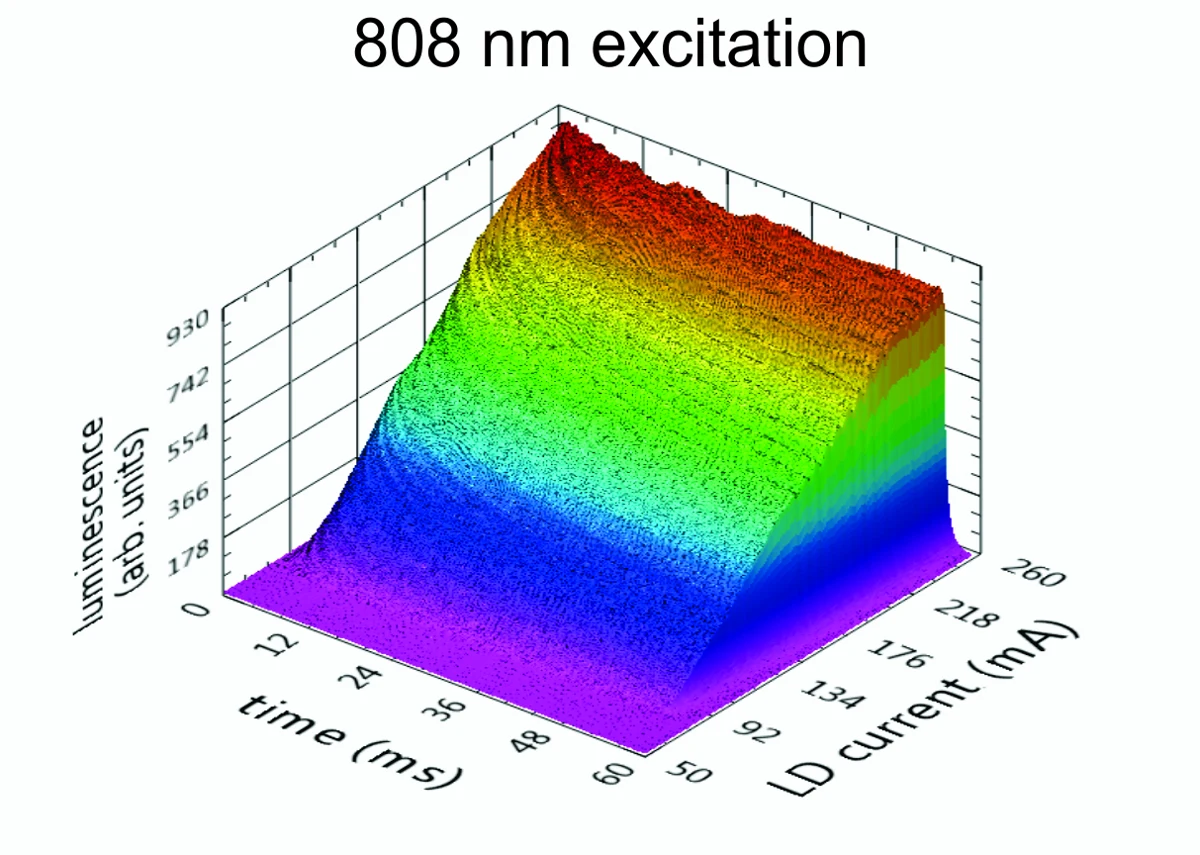
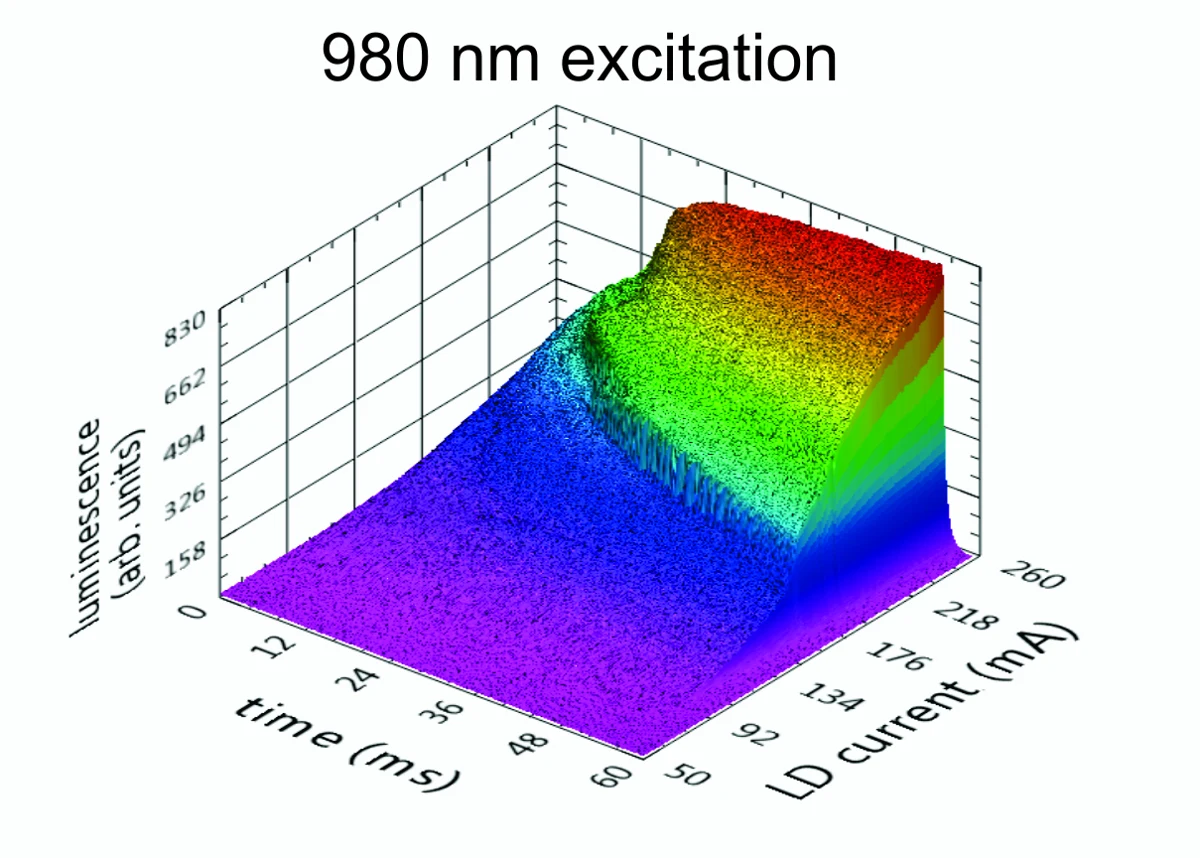
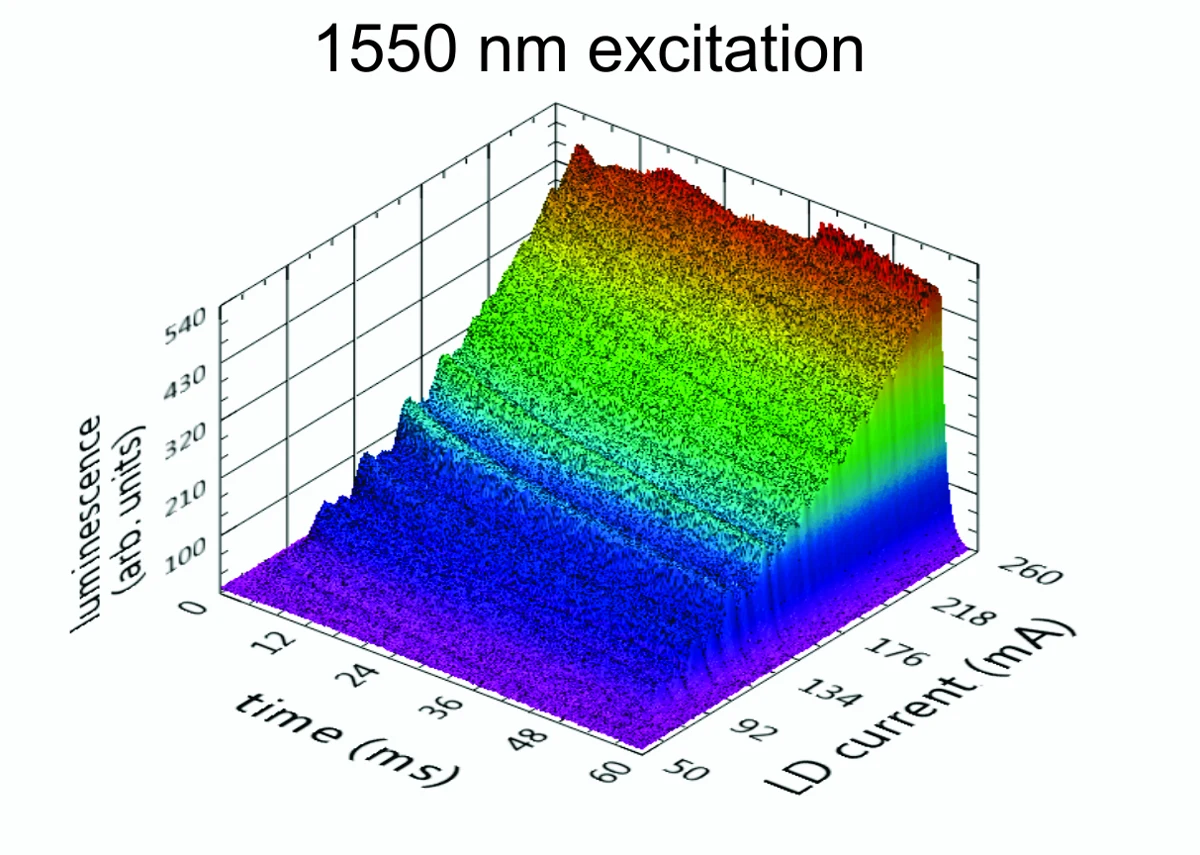
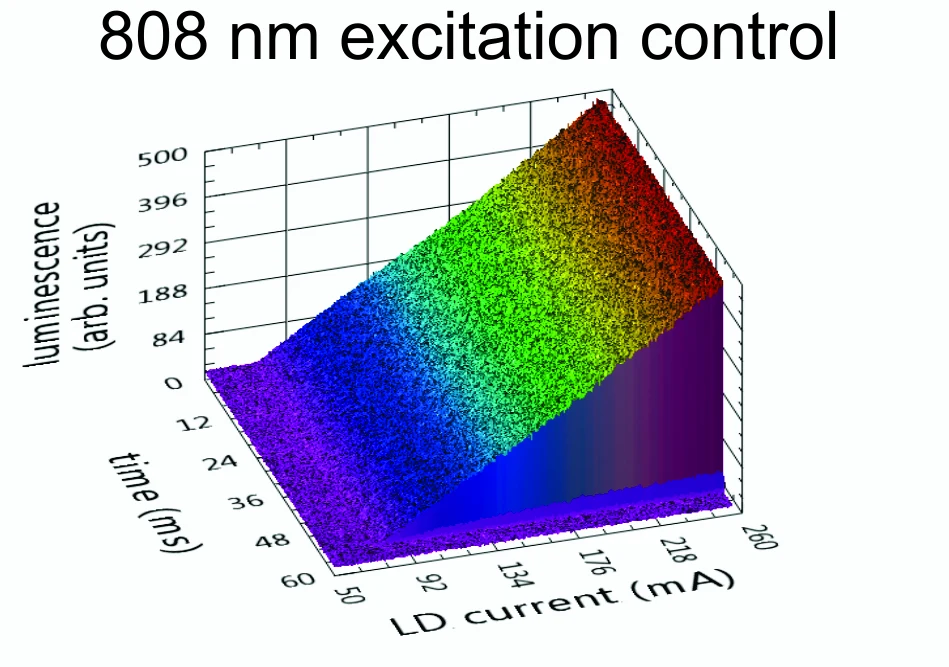
Green light vs. laser power, one wavelength at a time.
Each surface follows green emission (arbitrary units) through a 60 ms window while the laser-diode drive current is stepped from 50 to 260 mA. Same crystal, three excitation wavelengths, plus an 808 nm control. The blue and red surfaces look similar. Click any panel to enlarge.
Measured dataScale to 930 (arb. units)Measured dataScale to 830 (arb. units)Measured dataScale to 540 (arb. units) · telecom bandMeasured dataScale to 500 (arb. units)
The same crystal answers 808, 980 and 1550 nm light, and each wavelength leaves a different shape of response as power rises. That is the kind of fingerprint an IMS reader is built to check.
Measured data · thermal phosphors
The crystal is also a thermometer.
Heat a rare-earth phosphor and its light changes in a predictable way. In this IMS thermal-phosphor project the blue band near 455 nm grows steadily against the peak at 493 nm, from room temperature all the way to 1,100 °C. The ratio between the two is the temperature, read by light alone: no wires, no contact, through a window or into a flame.
Measured data
Intensity (a.u.)
Emission spectra of an IMS thermal phosphor from 26 °C to 1,100 °C, normalized to the 493 nm peak. Markers show the 455 nm band at the selected temperature, read from the figure.
Temperature
26 °C455 / 493 = 0.06
264007009001,100 °C
26 → 1,100 °COne ratio covers room temperature to the inside of a furnace in this data set.~1% per °CChange in the rise time of Y₂O₂S:Yb,Er powder between −50 and 100 °C, in the 2018 study below.One detectorRise and decay time sensors are not fooled by smoke, dirt or a tinted window that skews colors.
Publication · co-authored by IMS
MRS Advances · 2018 · Materials Research Society
Thermal and optical characterization of upconverting thermographic phosphor polymer composite filmsF. Sabri, S. W. Allison, M. Aryal (University of Memphis; Emerging Measurements), J. Collins and H. Bell (Intelligent Material Solutions)
Y₂O₂S:Yb,Er and La₂O₂S:Yb,Er were set into flexible silicone (PDMS) films and read with a 980 nm laser from −50 to +200 °C. Brightness, rise time and decay time all tracked temperature, making a thin, bendable, reusable temperature sensor. It is the same rise-and-decay clock we use to code a crystal.
Gd₂O₂S was already glowing in this building in 1971.
In March 1971, P. N. Yocom, J. P. Wittke and I. Ladany of RCA Laboratories in Princeton reported that rare-earth oxysulfides, La₂O₂S, Gd₂O₂S and Y₂O₂S, efficiently turn the infrared light of a gallium-arsenide diode into visible green (ytterbium and erbium) or blue (ytterbium and thulium). IMS works today in the same RCA / Sarnoff building, and the crystal on this page belongs to the same family.
Publication · RCA Laboratories
Metallurgical Transactions · vol. 2 · pp. 763–767 · March 1971
Rare-earth-doped oxysulfides for GaAs-pumped luminescent devicesP. N. Yocom, J. P. Wittke and I. Ladany, RCA Laboratories, Princeton, N.J.Read the paper ↗
Inert crystals. Data sheets on request.
Intelligent Material crystals are inert, inorganic solids, used at tiny loadings inside inks, plastics, fibers and adhesives. Safety Data Sheets (SDS) and Technical Data Sheets (TDS) are available on request under a non-disclosure agreement.