Send the sensor underground.
Bring the answer back.
Engineered sensor particles can be deployed into wells, fractures and reservoir fluids, interact with the underground environment, then be recovered and decoded. The goal is to turn the particle itself into a record of where it traveled and what it encountered.
A particle can carry identity and environmental response at the same time.
The IMS subsurface concept combines a stable particle core with engineered optical material and a surface or shell designed to respond to hydrocarbons or other target conditions.
One part of the particle answers which particle population is this? Another part can be designed to answer what did it encounter? That creates a multiplexed sensor that can be assigned to a well, stage, fracture network or injection event and later read after recovery.
Optical wavelength, rise/decay behavior, intensity and optional magnetic response provide multiple dimensions for distinguishing populations and confirming recovery.
Code each population.
Different host/dopant combinations and temporal responses can identify particles assigned to different wells, stages or zones.
Make the coating responsive.
Hydrocarbon-reactive or oleophilic layers can be designed so contact with reservoir fluids changes the optical environment around the crystal.
Protect the sensing engine.
Use ceramic cores, spacer layers and protective shells to separate optical function from pressure, temperature, abrasion and chemical exposure.
Read more than one signal.
Combine spectral, temporal, intensity, chemical and potentially magnetic measurements to increase confidence in particle identification.
Deploy. Interact. Recover. Decode. Map.
The value is not simply detecting a fluorescent tracer. The platform is intended to preserve a unique material identity while adding information about transport pathways and the chemical environment encountered underground.
Assign the code
Give each well, stage, zone or test condition a distinguishable material population.
Inject
Introduce particles with proppant, drilling fluid, completion fluid or another deployment stream.
Interact
Particles travel through fractures and reservoir fluids while responsive layers encounter hydrocarbons or other analytes.
Recover
Collect particles returning with the production stream or at a downstream sampling point.
Decode
Interrogate wavelength, lifetime, intensity and other response dimensions, then convert the measurements into spatial information.
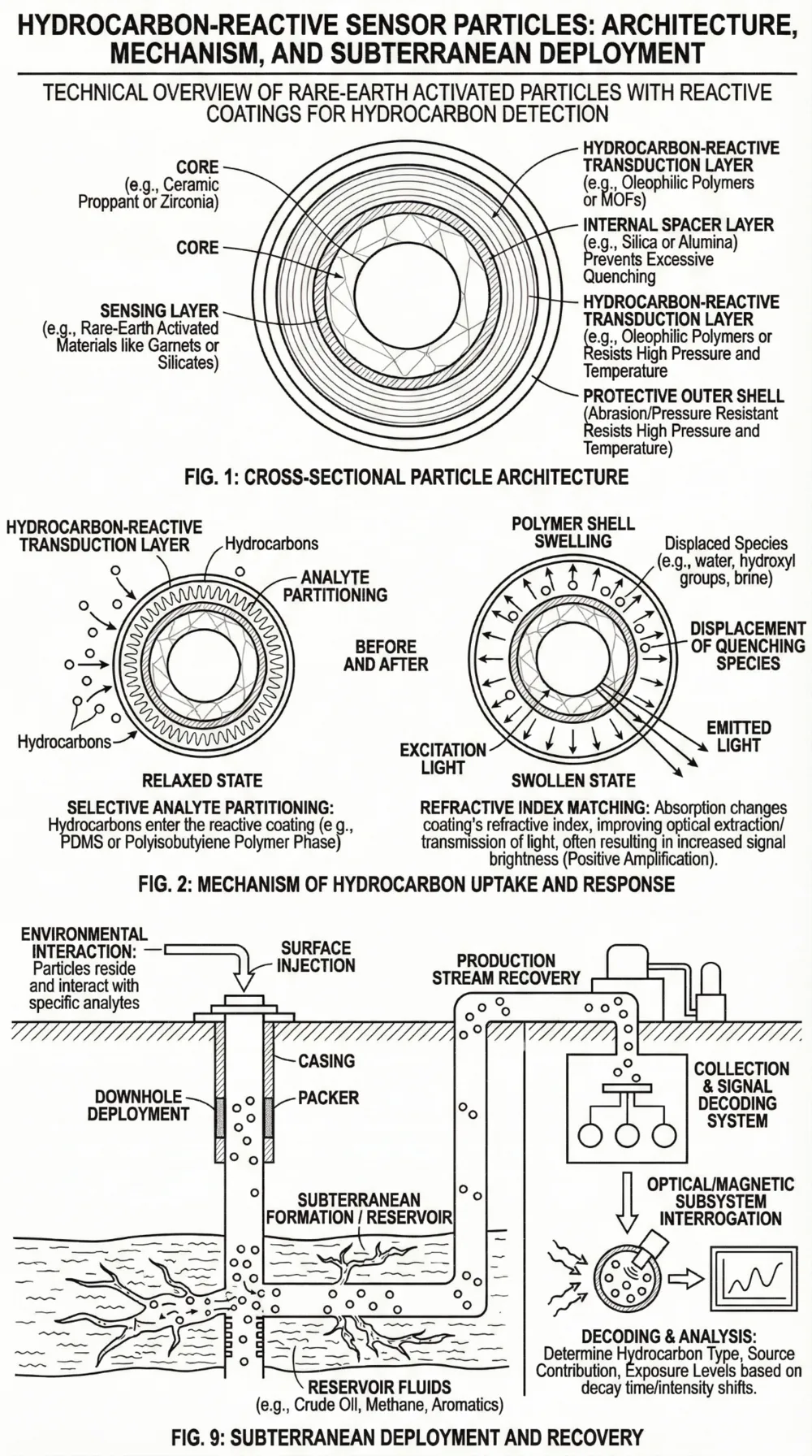
Build the sensor in layers.
A layered design lets each material do one job well: mechanical support, optical sensing, chemical response and environmental protection.
Trace the pathway. Sense the fluid. Reconstruct the reservoir.
The same particle platform can be configured for different questions depending on how much sensing chemistry is added to the identity layer.
Where did the injected material go?
Use persistent coded particles to distinguish wells, stages and fracture networks, recover them later and quantify connectivity or source contribution.
What did the particle contact?
Add a responsive coating intended to alter optical extraction, lifetime or another measurable feature after exposure to hydrocarbons or selected reservoir species.
Turn particle data into a map.
Combine identity, response and recovery data across many coded populations to infer hidden flow paths, fracture connectivity and hydrocarbon distribution.
Three different ways to engineer energy and information.
Oil discovery is the subsurface sensing branch. The adjacent energy pages focus on photovoltaic spectral conversion and light-driven hydrogen chemistry.
The particle goes where instruments cannot.
IMS can develop coded and responsive material systems for subsurface tracing, reservoir characterization and hydrocarbon-sensing programs.
Work with IMS