This is a spectroscopy application, not an Intelligent Material crystal application. Mid-infrared lasers and infrared detectors can measure trace gases above crops, locate emission hot spots and turn a field into a spatially resolved environmental data set.
The SMARTFARM program brought Princeton University, IMS and specialist laser partners together to build a practical way to quantify agricultural nitrous oxide emissions. The concept combined long-path mid-infrared spectroscopy around the field with a lightweight UAV sensor for spatial validation.

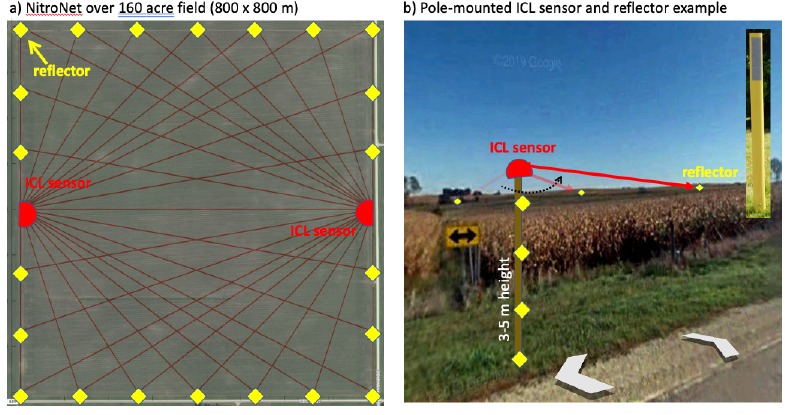
The original NitroNet architecture used scanning mid-infrared laser beams and low-cost retroreflectors around a field. Multiple path-integrated measurements can be reconstructed into spatial concentration maps rather than treating the entire farm as one average number.
That creates a route to finding both hot spots in space and hot moments in time — exactly the information needed when fertilizer, irrigation, soil and crop conditions vary across a field.
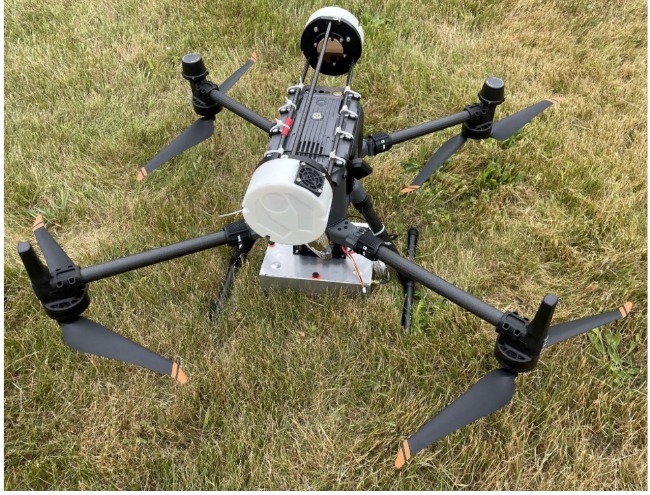
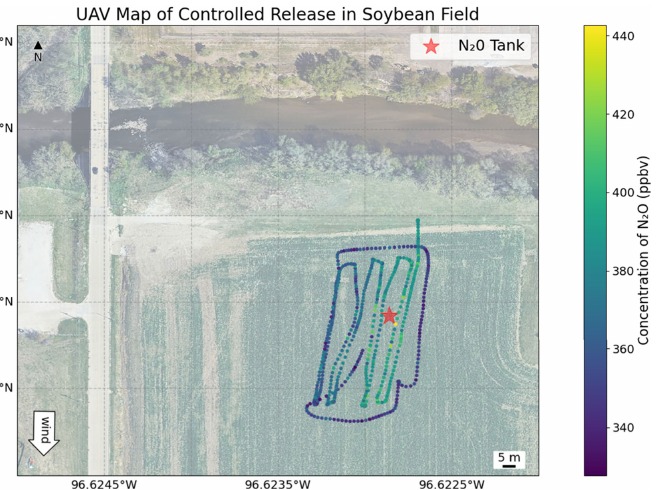
The later UAV system used an open-path ICL sensor and MCT detector to make geolocated N₂O measurements above agricultural fields. Laboratory measurements agreed closely with a commercial closed-path analyzer, and field flights mapped concentration structure across a soybean field.

The open-path architecture avoids a power-hungry sampling pump and keeps the system compact enough for UAV operation. GPS and high-rate measurements let each gas reading be tied to a location.
The same sensing approach can also move onto autonomous ground vehicles or portable platforms when the application calls for a different geometry.
Nitrous oxide is strongly tied to agricultural nitrogen use. Mapping its distribution creates a measurement layer that can be compared with fertilizer application, irrigation, soil conditions and management practices.
The point is not simply to detect N₂O. It is to provide spatial and temporal information that can support better decisions about where and when emissions are occurring.

The SMARTFARM work centered on nitrous oxide, but mid-infrared spectroscopy is fundamentally wavelength-selective. Changing the laser wavelength, optical path and calibration architecture opens additional agricultural and environmental targets.
Map N₂O concentration structure and identify hot spots and hot moments associated with field conditions and nitrogen management.
QCL-based architectures can target NH₃ for fertilizer, feedlot and agricultural air-quality applications.
The same broader mid-IR platform can be adapted to other molecular species where a useful absorption feature and deployable optical geometry exist.
IMS develops application-specific mid-infrared sensing architectures with Princeton and photonics partners for agriculture, environmental monitoring and other trace-gas applications.
Discuss a SmartFarm spectroscopy program →