Generate light
where the disease is.
Intelligent Material converts tissue-penetrating energy into localized light inside or adjacent to diseased tissue, creating a platform for photodynamic therapy, imaging and other energy-driven interventions.
The crystals make the treatment light where it is needed.
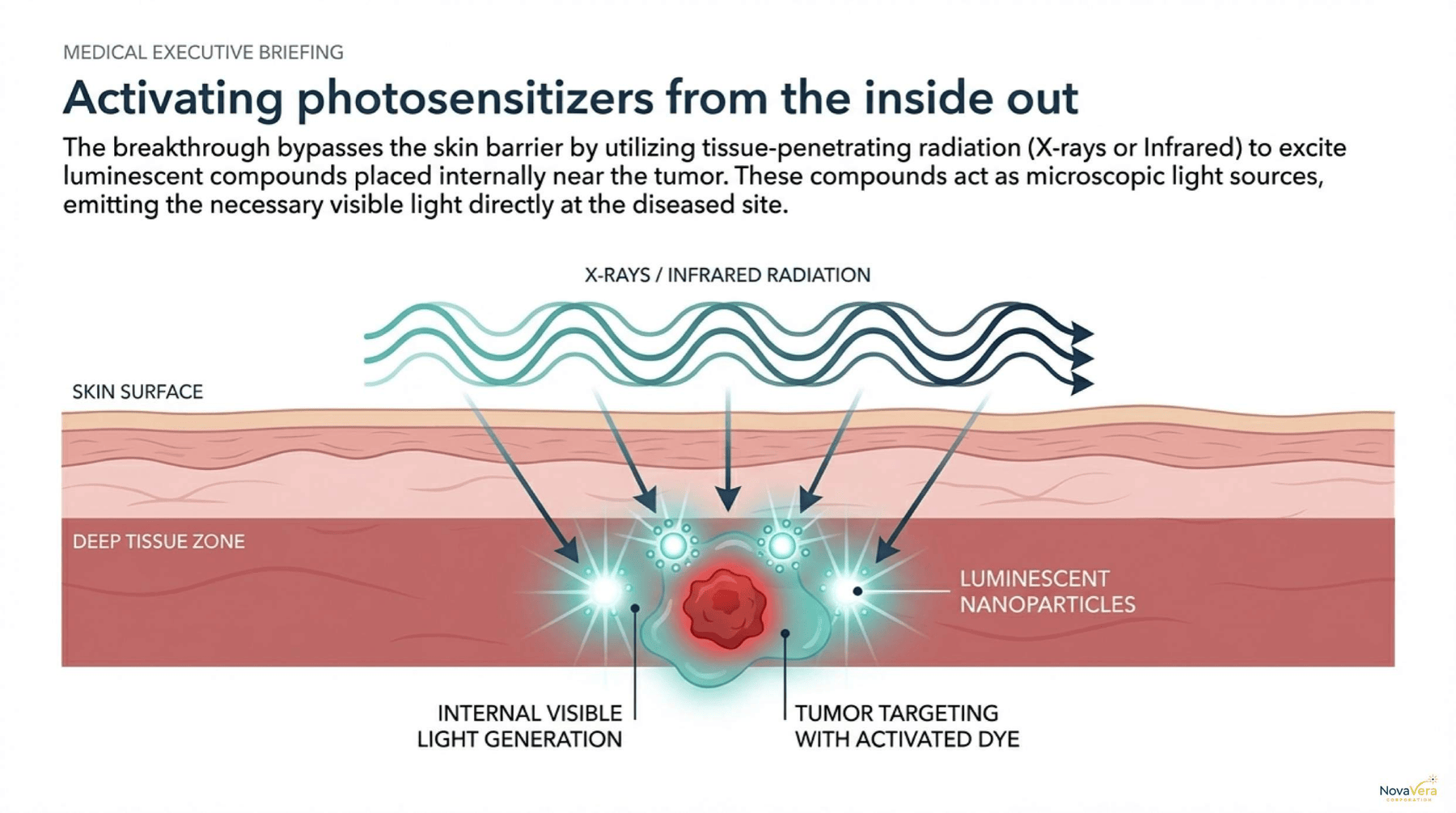
Conventional photodynamic therapy requires visible light to activate a photosensitizer. That makes surface and accessible disease comparatively straightforward, but visible light penetrates tissue poorly. The NovaVeraTx concept changes the geometry: deliver energy that penetrates farther, then convert it into the required light at the target.
This “inside-out” approach is the core of the program. The uploaded platform materials describe both infrared and X-ray activation, with Intelligent Material serving as the local energy-conversion element.
The PDT story, told by the people who built it.
A Discovery feature with Steve Hahn, Joe Friedberg and Josh Collins traces the early photodynamic-therapy work that led to today’s effort to generate the activating light closer to the disease.
Energy is delivered from outside.
Light is generated on the inside.
Tissue-penetrating trigger
Near-infrared light, X-rays or another selected energy source reaches the target region.
Intelligent Material
Engineered crystals absorb the incoming energy and convert it into a selected optical output.
Localized light
Emission is generated at or near the disease instead of relying on surface illumination.
Photosensitizer activation
The emission is matched to the photosensitizer absorption band.
Therapeutic effect
Activated photosensitizer transfers energy to molecular oxygen, generating cytotoxic reactive oxygen species.
Imagine trying to break down a door by throwing a billion loose toothpicks at it, one at a time. Nothing useful happens. Glue three million of those toothpicks together and now you have something that can act like a ram.
The analogy is not literal photon counting, but the idea is similar. Near-infrared light passes through tissue well, yet each infrared photon carries too little energy to activate most photosensitizers. Our rare-earth crystals can absorb several of those lower-energy photons and emit one higher-energy photon locally, creating the wavelength needed inside tissue to activate a photosensitizer, a light-triggered drug, or another photochemical function.
One materials concept.
Multiple activation pathways.
Infrared-activated PDT
Rare-earth crystals can absorb near-infrared excitation and emit shorter-wavelength light selected to overlap a photosensitizer. The concept is aimed at moving activation deeper than direct visible illumination.
X-ray-activated PDT
Scintillating or energy-converting materials can convert ionizing radiation into localized optical emission, creating another path to activate photosensitizers at depth.
Biodegradable materials
The program includes biodegradable hafnium-oxide concepts, alongside rare-earth hosts, for applications where the material should perform its function and then clear or degrade.
Localized delivery
Potential embodiments include intratumoral delivery, implantable depots, hydrogels, targeted particles, brachytherapy-adjacent systems and fiber-optic or wearable activation hardware.
The uploaded program deck describes intratumoral/implantable localization, degradable embodiments, wearable activation systems and endoscopic/fiber-optic delivery concepts.
The therapy starts with the crystal.
We can tune the material to the energy source, photosensitizer and delivery route rather than forcing one material into every indication.
This program did not start yesterday.
Early SPIE work in pleural PDT
Joseph S. Friedberg was a co-author on the SPIE paper The ratio of the spherical and flat detectors at tissue surfaces during pleural photodynamic therapy, part of the early Penn/Jefferson clinical and dosimetry work around pleural PDT.
View the SPIE paper →Measuring light in human pleural PDT
Friedberg also co-authored the SPIE study Diffuse reflectance spectra measured in vivo in human tissues during Photofrin-mediated pleural photodynamic therapy, extending the focus on understanding and controlling light delivery in patients.
Read the paper →Sunstones: infrared energy converted into therapeutic light
The SPIE paper Infrared light utilized for photodynamic therapy by activation of rare earth phosphors for visible light generation brought the materials and PDT programs together. Collins, Friedberg, Bell and colleagues reported using 808 and 980 nm infrared excitation to generate visible emission near 550 and 663 nm, wavelengths selected to overlap photosensitizer absorption.
Read the 2007 SPIE paper →From infrared to X-ray activation
The concept then expanded from infrared excitation to diagnostic X-rays. In Novel applications of diagnostic X-rays in activating photo-agents through X-ray induced visible luminescence from rare-earth particles: An in-vitro study, the collaboration described converting X-ray energy into visible emission that could activate photo-agents at depth.
Read the 2010 SPIE paper →Move the light source to the disease
NovaVeraTx builds directly on that progression: clinical PDT and dosimetry, then Sunstones infrared-to-visible activation, then X-ray-to-visible activation, and now a broader Intelligent Material platform engineered around the energy source, material, photosensitizer and delivery system as one integrated therapeutic architecture.
A signal worth pursuing.
Program materials supplied by IMS summarize both ex vivo lung-cancer experiments and an in vivo murine mesothelioma study using an infrared/material/photosensitizer combination. These results are preclinical, not evidence of clinical efficacy.


These values are taken from the uploaded program deck.
Where local energy conversion could matter.
These are research targets and platform-expansion concepts described in the supplied materials, not approved indications.
IMS intellectual property.
NovaVeraTx development.
Intelligent Material Solutions develops and owns intellectual property around energy-converting materials. NovaVera Corporation is the commercialization arm for the technology, with NovaVeraTx focused on therapeutics.
The objective is to combine materials science, optical delivery, pharmacology and clinically experienced PDT leadership into one development program.
Discuss a therapeutic program