Read the environment
molecule by molecule.
Mid-infrared spectroscopy can identify gases and chemical species from their molecular absorption fingerprints. IMS combines tunable QCL / ICL sources, sensitive infrared detection, field-ready optical architecture and application-specific materials to move those measurements from the lab into farms, factories, cities and remote infrastructure.
Let the molecule identify itself.
Mid-IR light overlaps strong molecular vibrational bands. Instead of inferring chemistry from color alone, the optical system measures wavelength-specific absorption. The core engine is QCL / ICL + sample path + infrared detector + spectral analysis. Intelligent Material can be added where coatings, conversion, filtering or sample interfaces improve the system.
A reusable sensing architecture.
One core platform can be configured for open-path measurements, enclosed gas cells, liquid interfaces, stack monitoring, remote sensing and distributed environmental nodes.
QCL / ICL
Tunable, narrow-line mid-IR light selected around the molecular bands that matter for each application.
Air · gas · water
Open paths, multi-pass cells, ATR interfaces and flow-through geometries control how photons interact with the sample.
MCT / IR detector
Fast infrared detection measures the absorption fingerprint across the selected wavelengths.
Quantify + map
Calibration, spectral fitting, geolocation and network software turn optical measurements into useful environmental data.
Air, water, infrastructure and climate.
Environmental monitoring is not one instrument. It is a family of sensing systems built around the same molecular-measurement engine.
Greenhouse gases
Targeted mid-IR channels can measure key gases directly and quantitatively.
- CO₂, CH₄ and N₂O
- Agricultural and landfill emissions
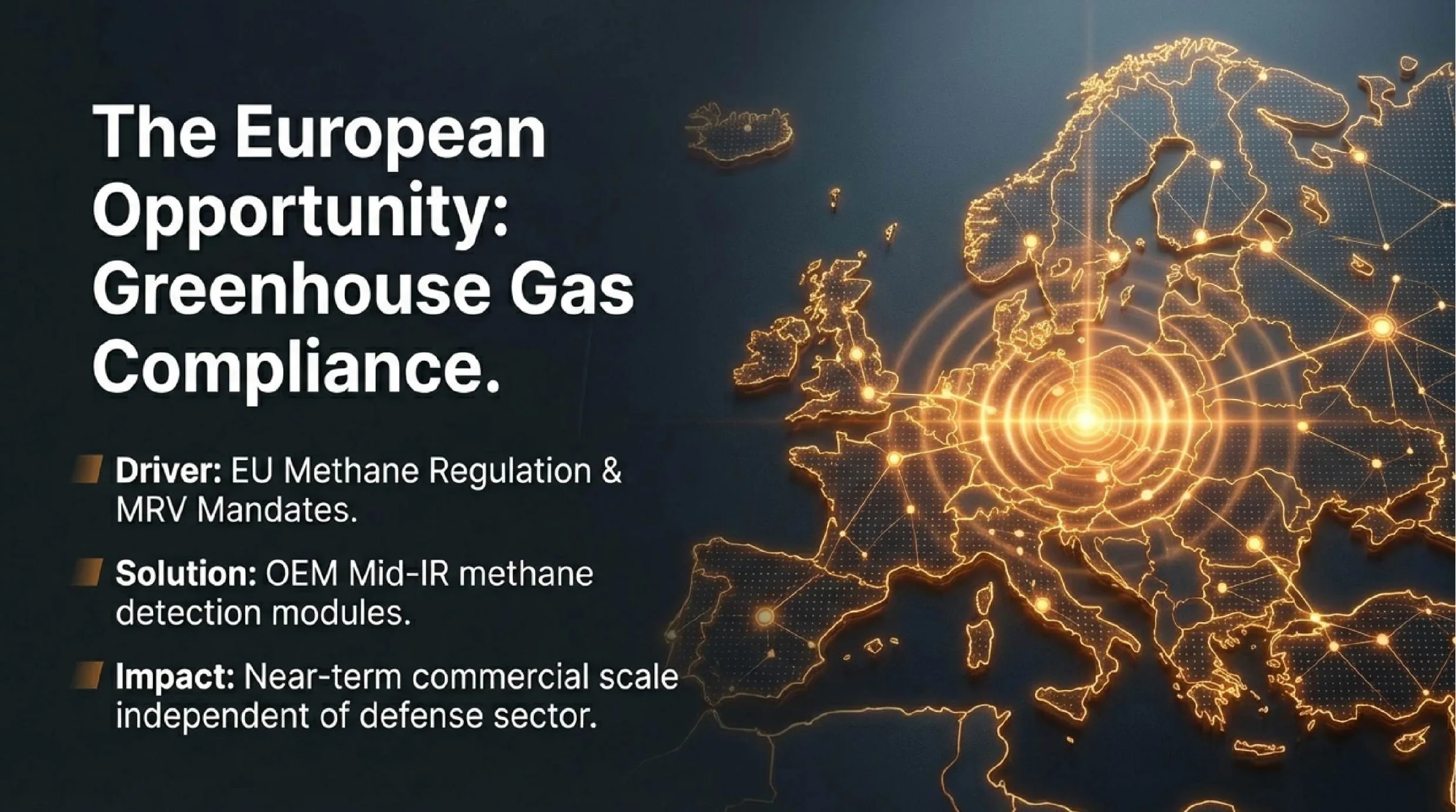
- Pipeline and oil/gas leak detection
- Carbon-flux and industrial monitoring
Air quality + VOCs
Selected gases and volatile compounds can be identified from their infrared signatures.
- Ammonia and selected NOx / SO₂ species
- Formaldehyde and industrial solvents
- Refrigerant leak monitoring
- Wildfire and combustion-gas studies
Industrial emissions
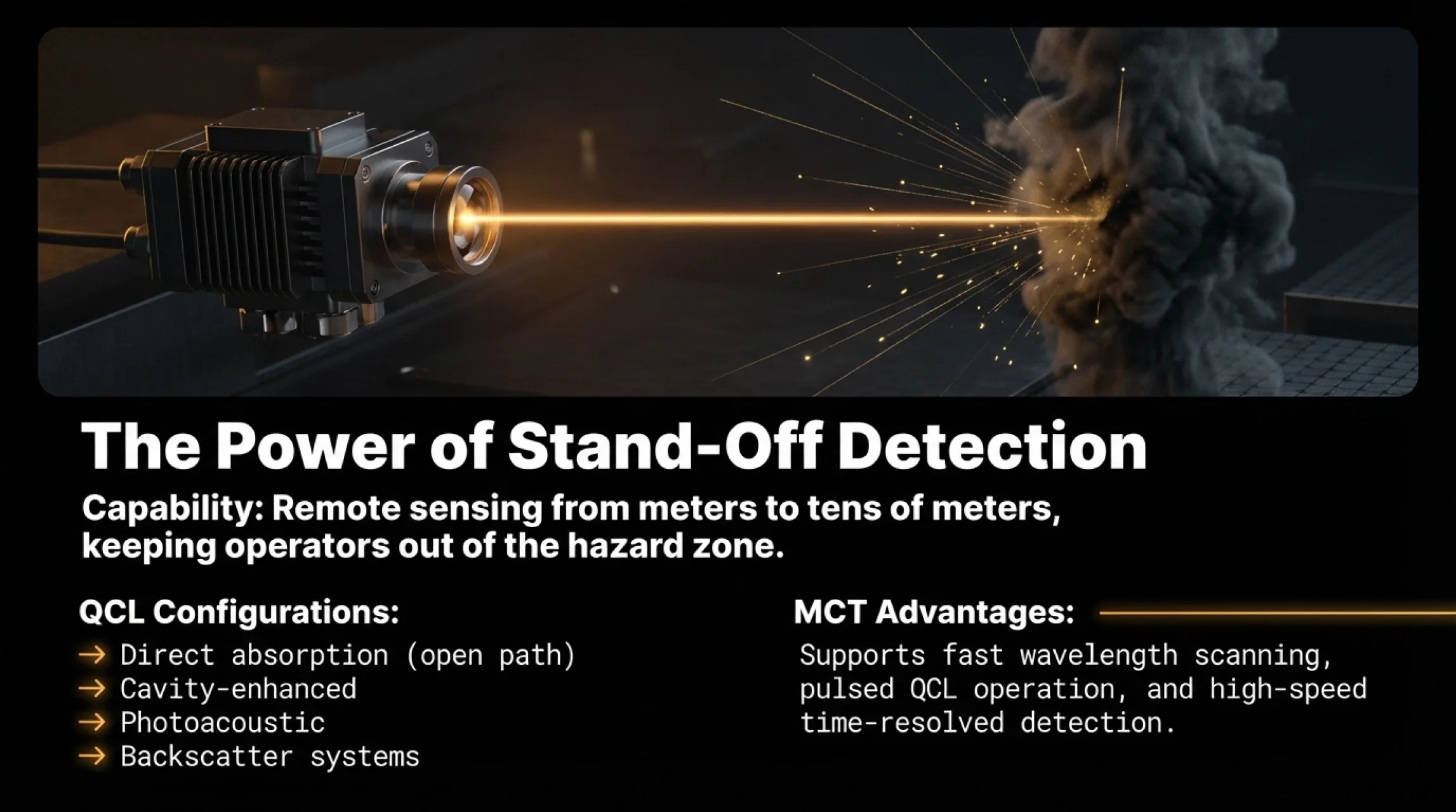
Fixed and stand-off systems can watch stacks, tanks, ducts and process areas for leaks or changing chemistry.
- Refineries and chemical plants
- Hydrogen and ammonia infrastructure
- Storage and transfer points
- Worker-area monitoring
Water + wastewater
IR spectroscopy and complementary optical interfaces can monitor selected dissolved organics, hydrocarbons and process chemistry.
- Wastewater process control
- Hydrocarbon / oil-spill signatures
- Agricultural runoff studies
- Flow-through optical monitoring
Indoor environmental health
Compact nodes can bring molecular sensing into buildings and controlled environments.
- CO₂ and ventilation control
- VOC and refrigerant monitoring
- Humidity and environmental context
- HVAC and building automation integration
Atmospheric research
Lightweight instruments can move measurements onto mobile and remote platforms.
- UAV plume mapping
- Field and coastal stations
- Boundary-layer studies
- Distributed climate measurements
From one instrument to a sensing network.
The same spectroscopy engine can be packaged differently depending on range, mobility and sampling requirements.
Fixed. Mobile. Autonomous.
Environmental sensing becomes more valuable when it can be deployed continuously. IMS can develop optical modules for fixed infrastructure, portable instruments, UAV payloads and networked nodes.
Where materials can add another dimension.
The spectroscopy platform does not depend on Intelligent Material crystals. But materials engineering can create useful secondary functions around the optical system.
Optical conditioning
Filters, absorbers, coatings and wavelength-selective structures can reduce stray light, shape bands and improve optical packaging.
Sample interfaces
Engineered surfaces, ATR structures and microfluidic interfaces can increase useful photon interaction with small gas or liquid samples.
Passive indicators
Application-specific coatings could be developed to record humidity, heat, corrosive exposure or chemical contact through an optical change.
Wavelength conversion
Where the physics and efficiency support it, conversion materials can be investigated for moving selected signals into detector-friendly spectral windows.
Multi-modal sensing
Combine mid-IR molecular absorption with visible/NIR, fluorescence or scattering channels when no single modality provides the full answer.
Physical identity
Intelligent Material signatures can authenticate field sensors, cartridges and replaceable optical modules as part of a trusted monitoring network.
Build around the environment being measured.
Fixed monitoring node
For stacks, pipelines, HVAC, industrial sites, farms and infrastructure where continuous trend data matters.
UAV / mobile mapper
Lightweight spectroscopy combined with GPS and mapping software for plume localization and field surveys.
Portable analyzer
Swappable gas, liquid or surface interfaces around a common optical engine for field investigation and validation.
This grows directly from the IMS spectroscopy platform.
The environmental page focuses on applications and deployment. The Spectroscopy page explains the QCL / ICL, MCT detector, calibration and molecular-measurement architecture in more detail.
Measure the chemistry, map the change, act earlier.
IMS develops environmental sensing systems around the molecule, the optical path and the deployment environment rather than forcing every problem into one sensor.