Put the image
inside the volume.
Instead of creating an image on a flat screen, Intelligent Material can create visible points of light inside a transparent medium. Multiple infrared beams address the material in three dimensions so the light appears where the excitation conditions intersect.
Pixels become points in space.
The display medium can remain visually transparent until the correct optical excitation reaches a selected location. The system then scans those locations through the volume to build a three-dimensional image that can be viewed without a conventional flat panel.
Fill a transparent volume
Disperse very small Intelligent Material crystals in a transparent medium so the bulk volume remains visually clear.
Address with infrared light
Use controlled laser paths, timing and power to excite selected material populations inside the volume.
Light only the target point
The desired visible emission appears at the addressed location where the required excitation conditions are met.
Raster the volume
Move the excitation coordinates rapidly through space to form shapes, structures, markers and multicolor data.
The physics is already visible.
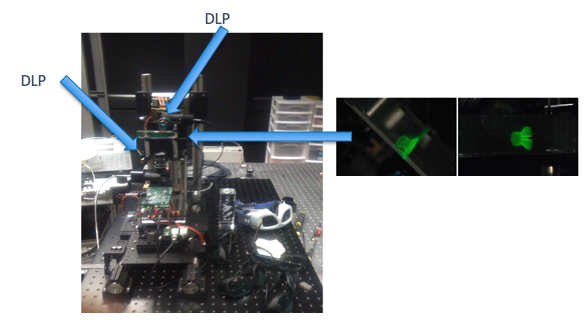
IMS has demonstrated image formation using dual optical excitation through perpendicular projection paths. The larger system concept extends that same principle into a transparent three-dimensional volume.
Dual-excitation image generation
The laboratory setup demonstrates spatially controlled visible emission from Intelligent Material when the optical excitation conditions are correctly combined.
Color from engineered material
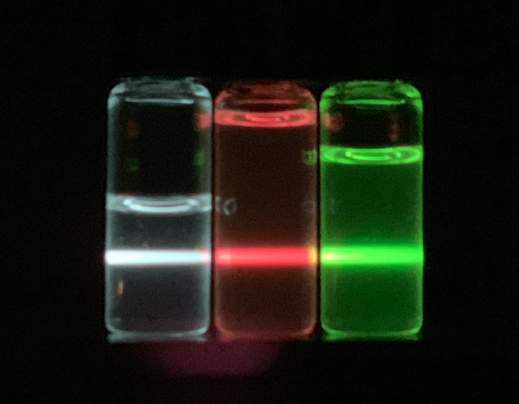
Different material compositions can produce different visible colors under infrared excitation. The development concept combines red, green and blue emission pathways and can also use multi-activator materials to broaden the available spectral palette.
The display starts with the crystal.
The key is not simply the laser scanner. The optical medium has to be engineered so it is small enough to remain transparent, bright enough to be read clearly, and spectrally designed around the excitation architecture.
Transparent media
Control of crystal size and morphology lets the material be designed for dispersion in a clear liquid or other host while minimizing visible scattering.
Engineer the physical particle for the optical volume.Reduce surface quenching
Shell engineering can isolate the optically active region from the surrounding environment and improve useful emission from small crystals.
Brightness is a materials problem as much as an optics problem.Design the color response
Rare-earth composition, concentration and multiple activators can be selected around the wavelengths, colors and excitation sequence needed by the display system.
Custom material instead of one fixed display chemistry.Three-dimensional information you can walk around.
The original IMS concept was built around data visualization rather than entertainment alone. The display volume can represent structures, moving objects and data layers using different colors and spatial positions.
Buildings + interior space
Recreate a compound, building outline, hallways or rooms as transparent volumetric geometry.
People + object location
Overlay color-coded points or objects within a larger three-dimensional structure.
Aircraft + submarines
Represent moving assets in true volumetric space rather than on a flat map.
Terrain
Render mountainous or complex geographic data where depth and elevation are part of the information.
Data streams
Assign color, position and motion to different data classes so relationships become spatially visible.
Custom visualization
Build the materials, excitation wavelengths and software around a company's specific three-dimensional data problem.
Start simple. Add color. Scale the volume.
IMS's development plan separates the problem into manageable stages: prove clear monochrome spatial imaging first, then add color, faster scanning and larger display volumes.
Monochrome volume
Optimize the transparent medium, laser geometry, focus and scanning logic around one emission color.
Multicolor addressing
Add independently controlled excitation channels and engineered materials for red, green and blue or other selected wavelengths.
Custom display system
Integrate optics, scanning hardware, software, enclosure and eye-safety engineering around the customer's use case.
Design the material and the display together.
IMS can develop the crystal composition, particle architecture, excitation strategy and prototype optical system around a company's volumetric visualization problem.
Discuss a volumetric display project