Engineer the light.
Engineer the display.
Intelligent Material can become a configurable materials layer for photon conversion, light control, contrast management, secure optical modes and next-generation display architectures.
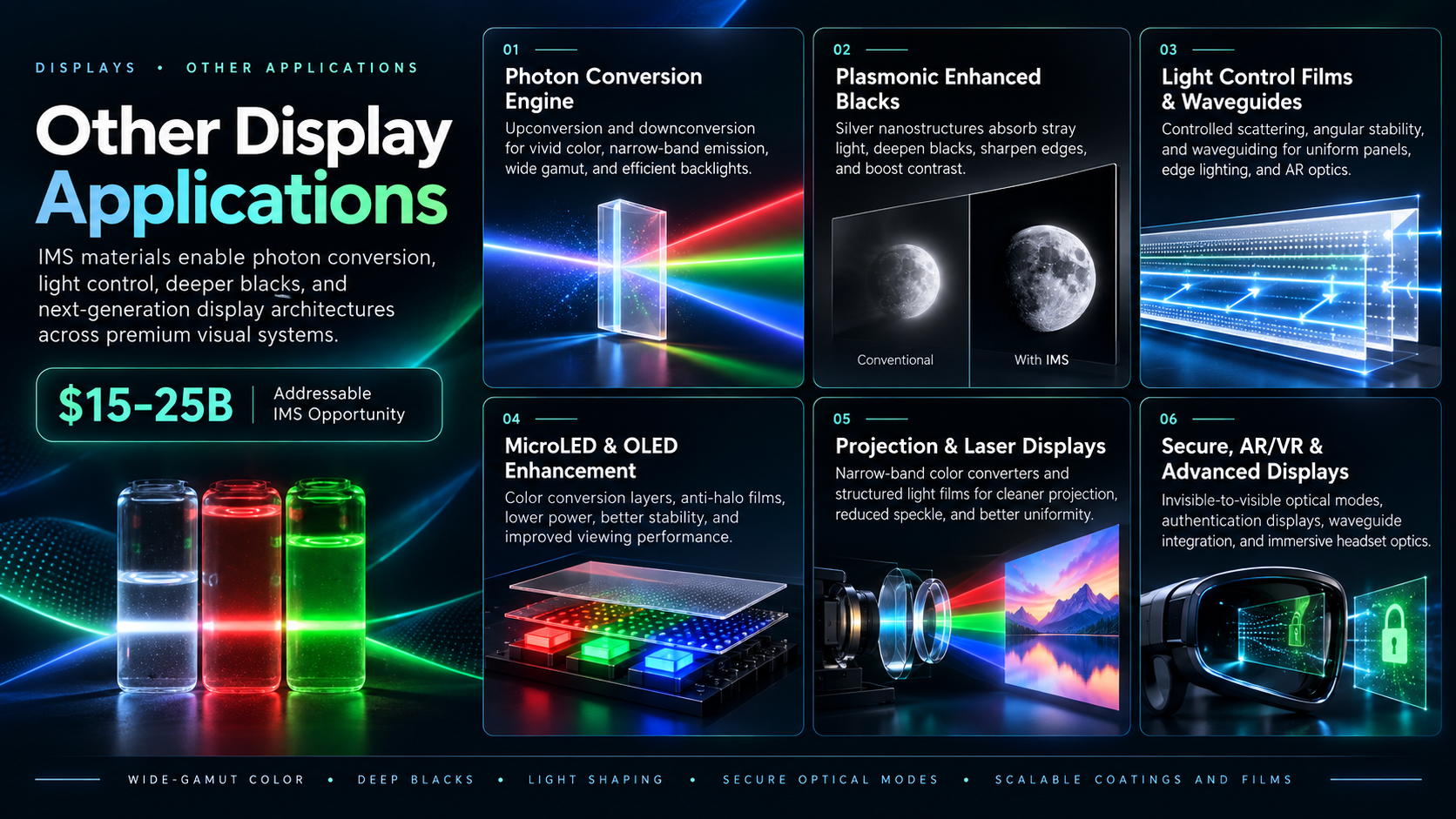
One materials toolkit. Many display layers.
The opportunity is not one display product. It is a family of optical materials that can be engineered around how a display creates, converts, guides, suppresses and delivers light.
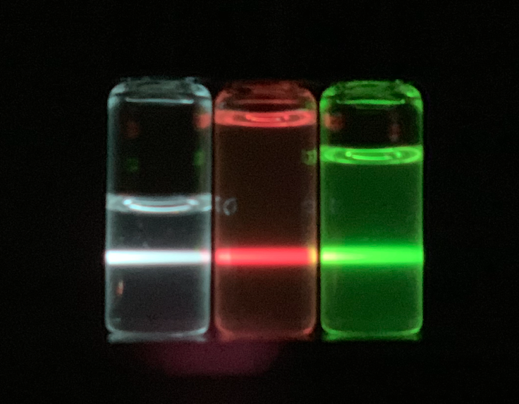
Upconversion + downconversion
Engineer materials to move photons between wavelength bands, enabling narrow-band color conversion, specialty backlights, projection engines and new excitation schemes.
- IR → visible / UV concepts
- UV / blue → visible conversion
- Multi-band emission from engineered materials
Deeper blacks. Cleaner boundaries.
Metal nanostructure and absorbing-layer concepts can be explored around black matrices, pixel boundaries and light-control films to suppress unwanted light and improve contrast.
- Ambient-light suppression
- Halo / flare reduction
- Subpixel light isolation
Scattering + waveguiding films
Particle size, refractive index and loading can be tuned to shape how light moves through a panel, film or optical stack.
- Viewing-angle control
- Uniformity + hotspot reduction
- Waveguide coupling concepts
Materials around the pixel
Intelligent Material can be developed as conversion, anti-halo, scattering or optical-isolation layers around very small emitters.
- Color conversion films
- Blue-leakage management
- Angular stability
Manage the light OLED already makes.
Research concepts include ambient-reflection control, photon recycling, scattering management and wavelength-conversion layers that may improve useful optical output.
- Ambient reflection reduction
- Photon recycling concepts
- Color-management layers
Laser + projection display materials
Use engineered crystals and optical films as narrow-band converters, durable phosphor-like materials and light-shaping layers for projection architectures.
- Laser color conversion
- Speckle / uniformity concepts
- Ultra-short-throw light control
Invisible excitation. Visible information.
Upconverting surfaces can create display modes where information is activated by infrared excitation and becomes visible only on an enabled surface or with the proper optical interaction.
- Authentication kiosks
- Secure terminals
- Covert / controlled optical modes
Materials for compact optical systems
Custom particles and films can be developed around waveguide coupling, spectral management, pixel-edge blending and light redistribution in immersive displays.
- Waveguide integration
- Spectral tuning
- Brightness / uniformity management
A materials layer that can fit the process.
Depending on chemistry and formulation, Intelligent Material can be developed for inks, coatings, films, polymer dispersions and patterned layers.
- Printable / coatable formulations
- Polymer dispersion
- Thin-film integration
Design the optical response instead of accepting it.
IMS can tune host lattice, dopant selection, concentration, particle size, morphology, core/shell architecture and surface chemistry around the display stack rather than forcing a display to work around an off-the-shelf material.
Custom material development for display companies
Start with the optical problem: excitation wavelength, desired output band, linewidth, lifetime, power density, scattering level, film chemistry, thermal environment or geometry. IMS can develop candidate Intelligent Material systems around those requirements.
Where the material can sit.
Different display architectures need different optical layers. IMS can target the parts of the stack where wavelength conversion, contrast, scattering or spectral control create the most value.
Conversion + isolation + light control
Explore film-based color conversion, pixel-boundary absorption, anti-halo layers and angular-management films without requiring every function to live inside the emitter itself.
Materials around the pixel can be as important as the pixel.Reflection + recycling + spectral management
Use optical layers to reduce unwanted ambient return, redirect useful emission and explore spectral conversion strategies around existing OLED light sources.
Improve what reaches the viewer.Laser-to-color conversion
Engineer narrow-band converting materials and light-control films around laser engines, projection optics and specialty illumination geometries.
Turn the material into part of the projection engine.Compact optics with engineered media
Develop waveguide-coupling, scattering and spectral-control materials around the difficult brightness and color-uniformity problems in head-worn displays.
Thin optical systems need highly controlled materials.Ink. Film. Polymer. Coating. Patterned layer.
The display platform is strongest when the material can be adapted to the manufacturing route already used by the customer.
Inks
Dispersed materials for printed optical features or selected regions.
Coatings
Functional layers for conversion, absorption or scattering control.
Films
Stand-alone optical layers integrated into the display stack.
Polymers
Bulk or molded transparent media containing engineered particles.
Patterned layers
Localized optical features positioned where the display needs them.
Volumetric display goes one step further.
Instead of improving a flat panel, the volumetric program uses Intelligent Material as the emissive medium itself, creating visible points of light inside a transparent three-dimensional volume.
Explore Volumetric Display →The missing materials layer for next-generation displays.
Tell IMS what wavelength, optical behavior, film chemistry, geometry or display problem you are trying to solve. We can design candidate materials around the system.
Discuss a display program